Growth strategy
Pricing a voice for India
A GrowthX capstone on ElevenLabs' India business: 69 user calls, a three-ICP framework, and a re-derived price ladder for a market where the first paid action should cost ₹100, not ₹2,500.
- ElevenLabs·Notion·Google Sheets·Whimsical


Every number on this page comes from a capstone project, and the page treats that honestly: the global figures about ElevenLabs are public and cited in the source; the India figures — the ₹30 crore baseline, the client counts, every projection — are the squad's own model, built from interviews and public benchmarks, because ElevenLabs has never published India revenue. Where a chart draws the model, its source line says so. Nothing here is a claim about the company's actual books, and no interviewee, teammate, or prospect is named anywhere on it.
The assignment was blunt: take a real company, build the growth strategy its India business would need to triple in a year. Nine of us picked ElevenLabs — the voice-AI platform whose models were everywhere in 2025 — and spent six weeks on a question that got sharper the longer we looked at it: why does a product this loved convert this badly in this market?
The answer the research kept returning was not awareness, and it was not quality. It was that the price ladder was built for a market with roughly ten times India's willingness to pay — and sixty-nine user calls said so in the same words, over and over.
Sixty-nine calls in eleven days
The research came first and everything else stands on it. We sourced contacts from LinkedIn, Reddit, communities, paid ads, and our own networks, and ran a calling sprint through mid-April 2025 — 69 contacts, 55 completed calls, each one coded into a research database: ICP, segment, company size, seniority, whether they had actually used the product, and what they said about it.
69 contacts · 55 completed calls
Completed calls per day, April 2025
Plate 01. Sixty-nine research contacts, one square each, coloured by segment. Slice the field by any dimension — the marks outside the slice recede rather than vanish, so the denominator stays countable. Below, the sprint's shape: completed calls per day, peaking at seventeen in one day.
The capstone's research database, anonymised at extraction — names, companies and roles never entered this site's repository.
I owned the calling operation, and the discipline that made it usable later: every call left with the same fields filled. When the notes were coded, six churn themes accounted for nearly all of the negative signal — and the top of the list was not a product complaint.
- 1Pricing & transparency50 insights · 27%SME & creator
- 2Audio quality & pronunciation45 insights · 23.5%SME & creator
- 3Unclear feature journey33 insights · 18.1%Creator
- 4Reliability & latency32 insights · 17%SME
- 5API integration & cost ramp27 insights · 14.9%Enterprise & SME
- 6Missing locales & accents23 insights · 12%SME & creator
Plate 02. Six churn factors, by volume of supporting insights across the call notes. Pricing and its opacity beat every product complaint — including the Indian-accent gaps everyone assumed would top the list.
The squad's own coding of the call notes. One honesty note: the capstone's summary table and its six per-factor pages disagree on two of these counts — locales and reliability appear transposed — so treat those two bars as ±1 rank.
Two quotes carried the whole finding. A startup co-founder, on why they left after their grant credits ran out: "we had to operate within pricing ceilings in the Indian market." An agency filmmaker who loved the product — "I'm amazed and floored by ElevenLabs" — and still rated the pricing jump as the thing that would eventually push them out. The product was winning the demo and losing the invoice.
Three customers, not one
The calls also broke the market into three customers who share almost nothing but the product. I built the ICP framework: twenty dimensions per segment, from decision-maker to sales cycle to compliance exposure. It became the spine every lever hung off — each initiative in the capstone targets one or two of these columns, never vaguely "users."
| Dimension | Enterprisee.g. a national airline | SME & startupe.g. a voice-agent startup | Creator & individuale.g. a business-content youtuber |
|---|---|---|---|
| Estimated cost reduction | Up to 90% | Up to 70% | n/a — the gain is speed |
| Turnaround-time gain | 50–100× | 10–100× | 10–20× |
| Sales cycle | 6–8 months | 1–3 months | Up to 1 month |
| Contract shape | 1–3 year contracts | Monthly or annual SaaS | Monthly SaaS |
| Annual budget | $500K+ | ~$25K | $500–$1,500 |
| Upsell potential | Medium | Very high | High |
| Cross-sell potential | Very high | High | Low |
Plate 03. Three customers side by side across twenty dimensions. The economics group is the one to read first: a 6–8 month enterprise sales cycle against a creator's sub-month impulse purchase, and a $500K budget against $500, inside one product.
The capstone's ICP comparison table, reproduced dimension-for-dimension. The source's exemplar companies are replaced by their categories.
I also tore down the product's own onboarding, screen by screen, to see what a new Indian user actually meets in their first hour — the moment the research says decides whether a creator stays.
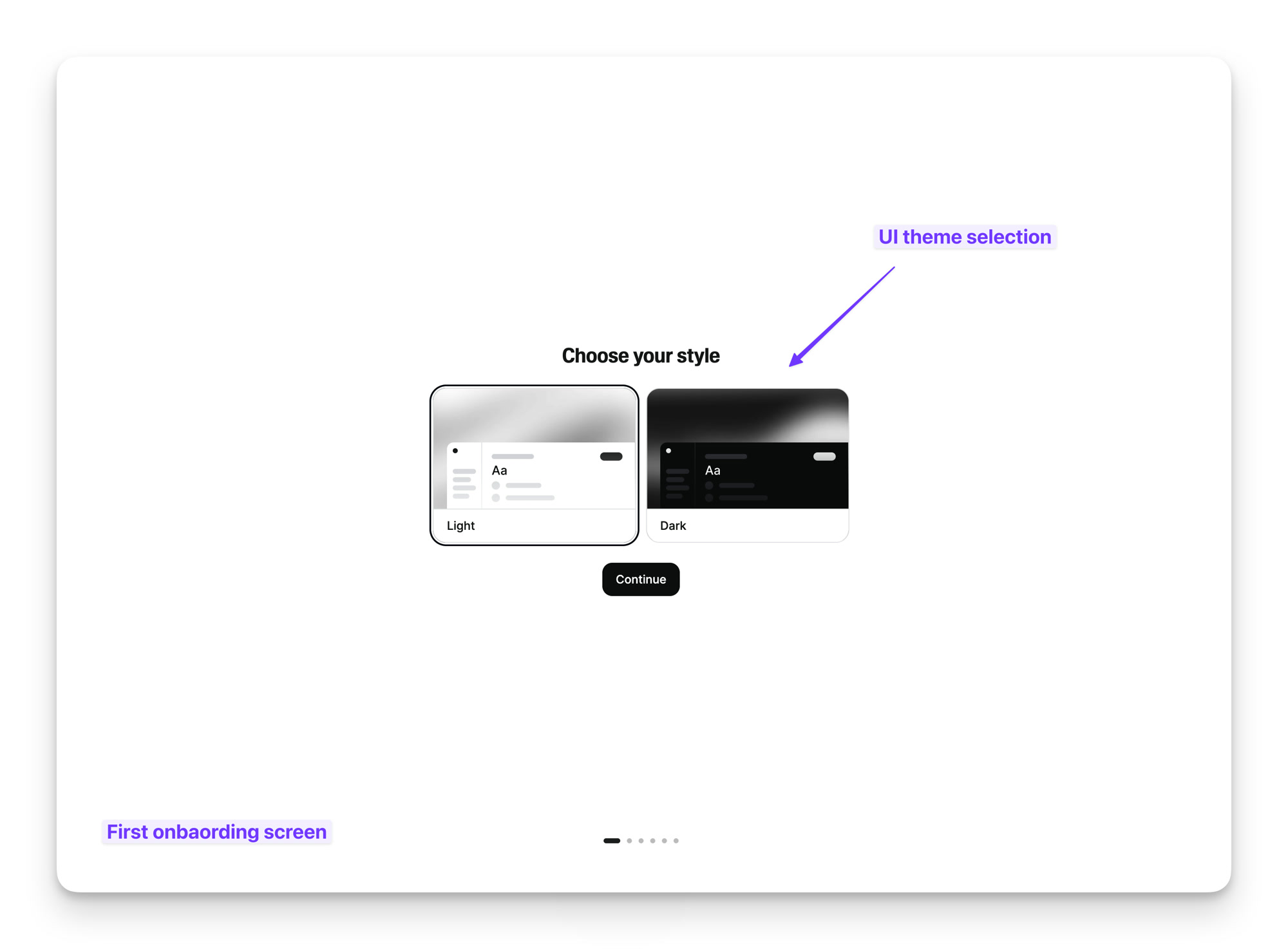
Plate 04. One frame from the onboarding teardown: the first screen a new user meets. The annotations are the teardown's own.
The capstone's product-research workstream — my screenshots, ElevenLabs' interface.
What ElevenLabs actually charges
Before proposing anything we documented the ladder as it stood. It is six plans by ten metered modules — text-to-speech, transcription, voice changing, dubbing in four variants, and so on — each module with its own unit, its own allowance, and its own overage rate per plan. The complexity is not an accident of documentation; it is the product's pricing surface, and a non-technical buyer meets all of it.
| Plan | $/month | Included | Overage per 1,000 characters |
|---|---|---|---|
| Free | $0 | 20k chars | — plan stops |
| Starter | $5 | 60k chars | — plan stops |
| Creator | $22 | 200k chars | $0.15 |
| Pro | $99 | 1M chars | $0.12 |
| Scale | $330 | 4M chars | $0.09 |
| Business | $1320 | 22M chars | $0.06 |
Ten modules, six plans, four unit types, and a different overage rate in almost every cell — sixty pricing decisions before a buyer knows what a month costs.
Plate 05. Every metered module across every plan, at the rates the capstone documented in May 2025. The bar beside each overage rate draws the volume discount; an em dash means the plan will not sell more at any price. Free and Starter stop dead — hold that thought.
The capstone's transcription of ElevenLabs' public pricing page, May 2025. Dated by design: the analysis is of this ladder, so the page keeps it.
The ₹2,500 cliff
Here is the mechanic the churn data kept pointing at. A free user gets 20,000 characters a month. The moment they need character 20,001, the only thing ElevenLabs will sell them is the Creator plan — $22, which the capstone's own tables price at ₹1,892, and which the users we called rounded to ₹2,500 with taxes and card friction. There is no ₹100 step, no metered overflow, nothing between "free" and "a month of discretionary income for a student creator."
“Four and a half out of five… Indian voice choices still limited… high jump in plan pricing.”
“We had to operate within pricing ceilings in the Indian market.”
“Once the grant ran out… we moved to Cartesia and OpenAI.”
Plate 06. A free user's monthly cost against characters produced. Today's ladder runs flat at zero, then goes vertical: ₹1,892 or stop. The proposed meter replaces the wall with a slope that starts at ₹100. Three voices from the calls sit beside the shape they describe.
Today's curve from the documented ladder; the proposed slope from the capstone's metered rate card. Quotes verbatim from call notes, attributed by role only.
The finding generalises up the ladder. Users on the $22 plan told us they would buy a second $22 subscription before touching the $99 one — the jumps are that wrong for this market. Every gap in the ladder is a place where money was offered and refused.
Re-deriving the ladder
The monetization workstream — which I co-owned — rebuilt the ladder around a meter. The mechanism: when a plan's included characters run out, usage flows into priced bands that get cheaper as cumulative volume grows, and the first paid action drops from ₹2,500 to a ₹100 top-up. High-intent behaviour becomes visible (two top-ups in a month is a hand raised), and the upgrade nudge arrives when the meter says the user is already spending plan money anyway.
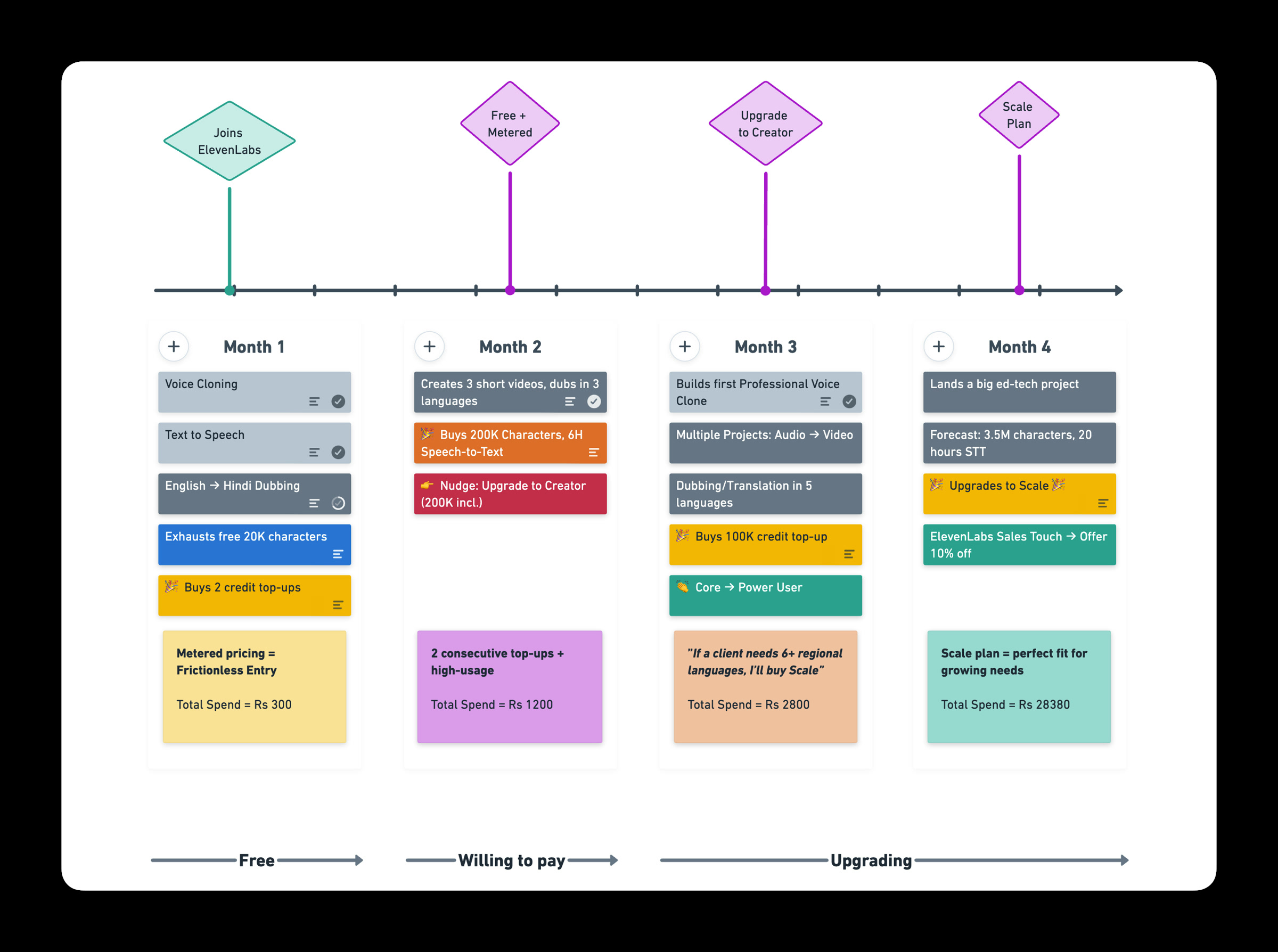
Plate 07. The proposal's own storyboard: a fictional eight-person agency moving from free, through ₹100–₹300 top-ups, to Creator in month three and Scale in month four — each step triggered by the meter's own signals rather than a sales call.
The capstone's journey diagram for the metered-pricing proposal. The persona is fictional and the source says so.
The rate card under it is exact, so this page computes it rather than quoting it. Pick a plan and a volume; both ladders price it live.
- —
- today: allowance spent, nothing to buy
- $2.33
- proposed · ₹200
- n/a
- today's ladder has no price here at all
Plate 08. Both ladders priced through the same engine. On Free, today's curve stops at 20,000 characters — the chart names the refusal — while the meter slopes on. On Creator and Scale the two ladders converge at the plan's own volume band, which is the design: the meter undercuts nothing, it fills the gaps.
Rates from the capstone's rate card, read as marginal bands — the source doesn't spell the band semantics out, and this reading is the only one where a bill never jumps at a threshold. The engine is diffed against 504 independently computed cases on every deploy.
The deepest part of the workstream never made it to a chart: the question of what legal entity should even collect these rupees. We priced four structures — an Indian subsidiary, a merchant of record, a direct gateway with permanent- establishment risk, and OIDAR-only — at the model's ₹90 crore target. The merchant of record costs about ₹4.5 crore a year in fees at that scale; the subsidiary about ₹1.8 crore in gateway fees plus fixed costs, at a 25–29% corporate tax rate instead of the 41–43% a permanent establishment would suffer. The recommendation: a merchant of record now, a subsidiary as the durable answer. It is the least glamorous page in the capstone and the one an operator would actually need first.
The rest of the board
The capstone was much bigger than pricing, and the fair way to show that is all of it. Twenty-three initiatives and workstreams, three lever families, one research foundation — with the ones I owned marked, and three of them wearing a strike through their name.
The growth model’s target: ₹30 Cr → ₹90 Cr ARR, and where the modelled ₹66.91 Cr of growth was assigned
23 tracked initiatives and workstreams
Acquisition
- Partner-led growth: AWS MarketplaceownedENT · SME₹12.35 Cr
- Event-led growth: a flagship voice-AI summitENT · SME · CRE₹24.7 Cr
- Account-based marketingENT₹4.12 Cr
- Content loopsCRE
- Paid adsownedWIPSME · CRE
- Organic & SEO auditSME · CRE
- QuickStart API journeycancelled — no reason recordedSME
Engagement & retention
- Nexus 50 — a closed-door quarterly forumownedENT · SME₹5.99 Cr
- Voice for Voice — credits for regional-language audioSME · CRE₹5.99 Cr
- Resurrection campaignsSME · CRE₹0.27 Cr
- Build with ElevenLabs — developer workshopsownedENT · SME
- ElevenCreator Loungecancelled — no reason recordedCRE
- Quarterly business reviewscancelled — no reason recordedENT
Monetization
- Metered pricing with micro-top-upsownedSME · CRE₹6.69 Cr
- Pricing & packaging reworkownedWIP
- Pricing-today teardownowned
Research foundation
- User calling — 69 research callsownedENT · SME · CRE
- ICP frameworkownedENT · SME · CRE
- Product onboarding teardownowned
- Market researchownedENT · SME · CRE
- Market sizing
- User segmentation (RFM)ENT · SME · CRE
- Product research
Plate 09. The growth model's revenue assignments, then every tracked initiative. The 'owned' ticks are this page's only attribution device — it was a nine-person squad, and the unmarked cards are teammates' work shown here as context. The dashed cards are the finding: three initiatives fully specced, then cancelled with no reason recorded anywhere in the workspace.
The capstone's levers database and growth model. Revenue figures are the model's own targets, not results.
Two of the unmarked levers deserve their cameo. The flagship acquisition bet was a two-day industry summit priced at ₹1.7 crore gross; the retention bet was Voice for Voice — a campaign inviting creators to contribute regional- language audio in exchange for platform credits, feeding the training data that would fix the Indian-accent gap the churn analysis ranked so high. The campaign's cost model priced crowd-sourced audio at about ₹6,200 an hour against ₹1–10 lakh for licensed recordings.
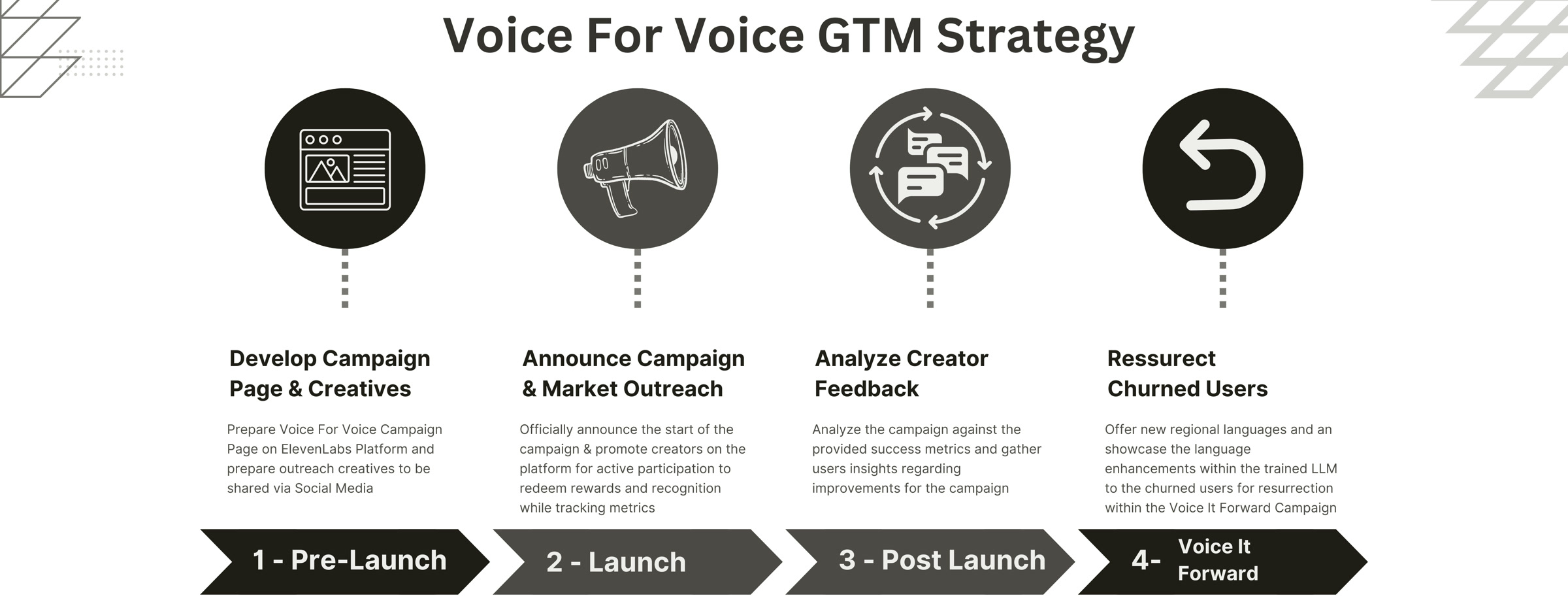
Plate 10. The campaign's four phases, from its own GTM board: build the pipeline, launch with creators, analyse the feedback, then use the newly trained languages to resurrect churned accounts. A teammate's lever; shown as the capstone's context.
The campaign's GTM strategy graphic, cropped to the planning band.


Plate 11. Campaign assets: a social creative and the contributor badge a Telugu speaker would earn — shareable by design, so every contribution advertises the program.
The capstone's asset library. AI-generated campaign creative; not ElevenLabs marketing.
Plate 12. The 42-second campaign advertisement — voiced, fittingly, with ElevenLabs' own tools. Re-encoded from the original for the web; sound on.
The capstone's asset library. Stock footage assembled with AI tooling; the voiceover is a squad member's cloned voice.
My other acquisition lever was quieter than a summit: put ElevenLabs on the AWS Marketplace, where Indian enterprise budget already sits pre-committed. The unit economics in the model were the best of any lever — about ₹40 lakh of cost against ₹12.35 crore of modelled revenue, because the channel rides procurement that already exists instead of building it. The plan ran fifteen tasks from seller registration to co-marketing, with metered billing integration in the middle — the same meter as the pricing proposal, which is not a coincidence: one mechanism, two levers.
- 69
- research contacts; 55 completed calls
- 6×10
- plans × modules in the documented ladder
- ₹100
- the proposed first paid action, was ₹2,500
- 504
- golden cases verifying this page's pricing engine
What I'd do differently
Code the calls while they're warm. Sixty-nine calls produced a qualitative goldmine, and the coding into countable themes happened weeks later, in one push, by tired people. The transposed churn counts this page flags — two factors whose numbers swapped somewhere between the sub-pages and the summary table — are exactly the kind of error that creeps in when analysis is batch work. Code each call the day it happens and the numbers stay attached to their evidence.
Write the cancellation memo. Three initiatives were specced to the point
of email drafts and revenue models, then abandoned with nothing but a
[Cancelled] prefix. The plans survived; the reasons died with the
decision. A three-line memo — what killed it, what would revive it — costs
five minutes and turns a dead document into a reusable one. The absence of
three such memos is the most instructive thing in the whole workspace.
Interrogate the retention assumption first. The model's road from ₹30 to ₹90 crore leans hardest on retention improving from 77% to 88%, and that single assumption has less evidence behind it than any other number in the model — it is a benchmark blend, not an observation. The pricing and channel work underneath it is real; the headline it rolls up to is only as good as that one row. If I rebuilt the model I would publish it as a sensitivity table with retention on the x-axis, so the reader watches the target move before deciding what to believe.
Ask the money question sooner. The entity-structure analysis — subsidiary versus merchant of record, the 25% versus 43% tax cliff — arrived in the final week and quietly governs everything the pricing proposal can promise. It should have been week two. In any cross-border pricing project, who is legally allowed to collect this money, and at what cost is not a detail to tidy up at the end; it is the ceiling on every number above it.